:::Annaviar Chelliah::: Little-known man behind well-known Tamil theatre
By: Professor Karthigesu Sivathamby
Source: Northeastern Herald
Kathiramalai Chelliah, one of the many unforgettable annavis of the Batticaloa kooththu tradition, passed away in Vantharamoolai last week at the ripe old age of 78. Sri Lankan Tamil theatre will always remember the annaviar as a virtuoso who helped late Professor S. Vithiananthan in the latter?s mission of modernising the kooththu dance form and enabling it to be brought to the Sri Lankan stage as modern Tamil drama. Annaviar Chelliah?s virtues as a trainer?presenter of the Batticaloa kooththu should be remembered gratefully and it is the duty Sri Lankan Tamil theatre historians not to forget to give him his due place.
The story begins in 1956; the year Prof. Ediriweera Sarachandra produced his epoch-making Maname, and openly stated that Maname nadagama is traceable to the Kooththu dance form of the Tamils. He had of course polished it, brought in Greek and Japanese conventions and enriched it with fulsome music, using the violin and sitar. But theatrically it belongs to Kooththu in Tamil that refers to the traditional dramatic presentation, which depicts a narrative through dance. Originally the word must have referred to a group dance (dancing a theme) with and through physical movement.
Traditional temple dances of Tamil Nadu had, over the years, marginalized the kooththu to the streets, so much so that it came to be known in that part of India as theru kooththu (theatre of the street). Nonetheless kooththu in classical Tamil continued to be known as dance / performance, and Lord Siva Himself, in the form of the great cosmic dancer, was called ?Kooththan? and the famous Saivite temple at Chithambaram where He is supposed to have performed the dance was called ?kooththambalam.?
Reduced to the streets, post 18th century theatre developments did not touch the kooththu of the lower strata of society and theru kooththu in Tamil Nadu was retained more or less as ritualistic theatre.
In the Jaffna District, puritanical social reforms brought in by Arumuga Navalar took away entertainment like the kooththu from the lives of the upper and even the middle strata of society, confining it to the depressed castes. In other Tamil areas where Navalar?s ideology did not rule supreme, traditional entertainment forms fared better. The Vanni seems to have had a flourishing kooththu tradition. Of course in Mannar, the enculturation of the Catholic Church was done through kooththu and the genesis of the Sinhala nadagama is, in turn, attributable to Catholic Tamil kooththus.
In Batticaloa, the situation was very different to Jaffna. ?Navalarism? did not gain ground there, nor was the caste heirachy strong. The kooththu tradition was preserved among all castes, from the agrarian caste to the service castes, from the fisher caste to the artisan castes. And as luck would have it the ritualistic character of the theatre was not lost either. Therefore, when Sarathchandra spoke of the kooththu one may only turn towards the Batticaloa District, where the tradition has remained intact.
Vithiananthan began his mission of retrieving and revitalising the kooththu tradition from 1956 onwards, when he was made the chairman of the Tamil Drama Panel of the Arts Council of Ceylon. He was the chairman from 1956 to 1967 and it was the proud privilege of the present writer (who was his student for both undergraduate and postgraduate studies) to work with him as secretary to the panel during that period. In the years 1956 to ?60, Vithinanthan with great perseverance and patience, developed and enabled the emergence of a young group of kooththu performers by nursing their skills and encouraging their enthusiasm from school days.
S. Mounaguru, the staff performer in Vithinanthan?s kooththu productions, was discovered in an inter-school competition in 1959 and that was the first time ever an inter-school kooththu competition was held. When a substantial group of young men arrived at the University of Peradeniya in 1961-62, Vithiananthan could plan in terms of an undergraduate production of the kooththu. Mounaguru, Perinpanayagam, Kanagaratnam and a few others, all competent dancers, were then undergraduates. The search was now on for a really competent annaviar who would understand the needs of a university production, and more than that, its significance.
The word annavi though it refers in common parlance to a traditional drama teacher-instructor is a derivation from the term ?annanthu nokkal? meaning looking upwards. The annaviar (the final ?ar? is an honorific suffix) was originally the man who led the team of dancers and was looked up to as the master. There is a social significance too in that these annaviars were also community leaders held in high esteem by society. Therefore, being an annaviar meant one who was committed to the preservation of the traditional dance form being polluted by extrapolations and novelties arising from individual fancies. Thus, it was essential to identify an annaviar who was not only a master of the art but also a man who could be flexible and be able to legitimise the flexibility. Above all, the would-be trainer had to fit into the halls of Peradeniya. Vithyananthan made the final choice from a list of good number of annaviars. The final choice was just the right one.
Annaviar Chelliah?s task was threefold: train the girls and boys to dance the kooththu, increase the performance capacity of those who already had some experience in the dance form and play the maththalam to bring out the dramatic potential of the ?arttams? (dances).
After much discussion ?Karnan por? (the Battle of Karna), an episode from the Maha Bharatha was decided upon as suitable for performance because of its high dramatic potential. As a play, full of scenes of combat, it was rich from the arttam perspective. The storyline was an intensely tragic one. Karna in the Maha Bharatha was the only warrior who could have won the war for Duriyothana, with his naga (snake) arrows ? ?nagasthram? ? but Lord Krishna creates diffidence in Karna by reminding him about his birth and manoeuvres it in such a way that he cannot use the arrows effectively. The play has great dramatic potential both as spectacle and as human drama.
Vithiananthan had to be careful. He had to make modern theatre out of kooththu, while at the same time not be accused of having hybridised the dance form. His student collaborators were for intensifying the dramatic part. But Vithiananthan did not want to cross the boarder. In retrospection, one sees the production itself was an intensely difficult one. At the time Karnan por was produced, the kooththu tradition was to perform the dances almost as a self-contained entity, while treating the dialogue as only marginally important for the arttam. This led to some serious difficulties: (a) the dance was taken as an end in itself; in fact it received a dominant attention, (b) the song which held the story and/or the conflict was virtually submerged by the dance and (c) the joint orchestration of the singers and the drums did not allow the communication of meaning to the spectators.
To one trained in the culture of kooththu, there was no problem in becoming a ?sahrdaya? (appreciating with oneness of heart) but to one unfamiliar with the idiom the performance merely meant spurts of songs and dances.
We wanted to mediate the songs to the dance steps thus bringing out the emotions clearly. This necessarily meant a slight slowing down in the pace, but it was essential for the ?drama.? It is here the annaviar?s virtuosity comes in.
To realise the importance of the annaviar, one should know his task. He is the trainer, the director, the dance master who controls the pace of the performance, but he is not a man behind the scenes, he is right in the middle of the performance placed usually on a circular stage (Vattakalari). He presents the play, plays the percussion instrument that determines the pace of the play, and by playing the maththalam he is also a performer. In the Vadamodi style, he stands at the centre and enables the unrestrained flow of the drama through his efficient drumming. In the Thenmodi tradition he is also an interlocutor, talking to the characters especially the less important ones. Thus he drums and acts.
Annaviar Chelliah rose up to the occasion marvellously. When he realised the dramatic variations in the story his rich drumming experience began to show itself. It could bring out all the nuances, soft and hard, through his fingers.
Another major concern of ours was to get the performers to ?act? ? to portray their characters. There was a fusion of Brecht and Stanislavsky and along with this was the more crucial part of making the dance steps an integral part of the dramatic exposition. Thus, the dance forms such as veesanam, became steps to help characterization. Thus there would be a difference in the gait of Karnan and Krishna and between Duriyothana and Veeman. An added problem was that girls did the female roles unlike in the traditional kooththu where men played the role of women. Fortunately, most of the female cast had been trained in Bharatha Natiyam. But they were not kooththu material. All this made Annaviar?s task only more difficult. It was not to be the kind of kooththu that we normally see. We were trying to distil the ?genunie? kooththu, which lay buried in the outer spectacle and dance. Chelliah Annaviar had the artistic sensitivity and the creative intelligence to immediately respond to his new challenges. His voice was his also an asset. All these combined to make Karnan or not only epoch making in its presentation but intensely human in the depiction.
A new leaf was turned in the annals of kooththu with the production of Karnan por. It was no doubt, a singular achievement of Vithiananthan?s, but it also that of Chelliah?s. His role as the presenter, made it look natural and easy flowing. The performance did not come across as a first effort, but as that of a polished professional.
Vithyananthan did three more plays with Annaviyar Chelliah ? Nondi Nadagam (1963), Ravanesan (1965) and Valivathai (1967). I was out of the Island in 1967, but had the privilege to be associated with the other two productions.
Ravanesan is a landmark in kooththu revival. The tradition was to do plays that had a written script. Ravanesan was different. We took the fall of Ravana as depicted by Kamban and got it written to suit the arttams the dances in the kooththu. Mounaguru did these transcreations. He made it a kooththu script. Then songs had to be written to the varying rhythms of the different dances. Much efforts went to this. A combination of dance rhythm, literary resonance and dramatic depth were equally essential. Mounaguru put into song what we decided. The Annaviar was not out of it. He too made his contributions.
In Ravanesan there was a blend of the new and old, the traditional and the modern. Such experimentation was possible because we had in Mounaguru a really versatile dancer. He could marry the steps to suit the mood. There were other performers too such as Perinpanathan who as Sallian in Karnan por brought out the intricacies of kooththu dancing in the most vivid manner. It was a sturdy performance that had a certainty and definitiveness of a talented dancer. One should not forget Kanagaratnam either, who was a great dancer. They were once-in-a-life time combination.
The richness was fortified by the assistance give by N. Santhalingam as makeup man and Kamala acca (Vithiananthan?s wife) as the costumer. N. Santhalingam?s makeup differed greatly from the traditional one, which usually looks gaudy and unnatural under electric lights. In one of the later productions Sithamparapillai of Alaveddy, a great folk singer and Udukku drummer was brought in.
It was the undoubted capability of Annaviar to combine such a diversity of inputs that led to performances of great authority and intense drama. However, he never tried to pose as one who knew every thing about kooththu during rehearsals. In fact one could accuse him of having hidden his talents. Off stage he was a very humble man and was not quite happy in his new Peradeniya environment. He enjoyed his drink and liked to have the bottle under his bed. But Vithiananthan in that sense was a hard taskmaster. He wanted Annaviar to enjoy his drink, but not become a drunkard. Understandably, some of us turned out to be quite intimate with him and the degree of intimacy depended on the periodic drink he wanted.
Annaviar Chelliah later became a much talked of artist. Mounaguru and his collaborators used him in their new productions. But Annaviyar was never able to overcome the pangs of poverty. At this point I should extend a word of appreciation to certain younger members of the staff of the Eastern University for helping Annaviar periodically. Had it not been for the generosity of those from the university?s Fine Arts Department, his position would have been much worse. It is a pity that the local Arts Council had not helped him to the extent it could have, and should have. In spite of all this the artist in him was never blunted. His conversation revealed his artistic depth and his integrity. May his soul achieve eternal bliss it fully deserves.


 Annaviyar Arumuham Rasiah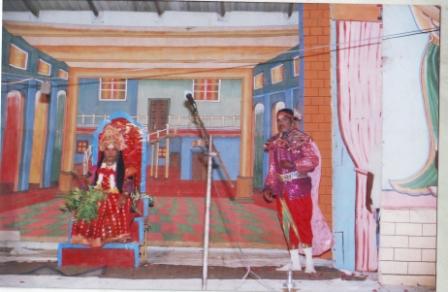


 "Thasakirivan Thawanilai" Vadamoodi Kooththu. Held on 22nd July,2010 night.


