Tuesday, February 27, 2007

Sons and Daughters of Mourning Mothers As “Dried Fish” in hue.


Sons and Daughters of Mourning Mothers
As “Dried Fish” in hue.


People will react when they saw the dead animals or birds or even small bugs.

Even though people like to taste varieties of butchered meat, they feel guilty for its precious life as a living species.

But it’s little bit doubt in the case of Dried Fish.

Mostly Dried Fish is being perceived as edible item not as a dead fish.
It’s a normal behavior of human beings.

Few may contradict logically.

But the basic intention is different and directly connected with love of life.

There are severe behavioral changes are being observed in our societies.

The life of people is lost its value and it’s normal to see bodies of sons and daughters scattered all around with multiple versions of reasons for their killings.

The distorted bodies, dried bodies under the hot Sun, tortured bodies, headless bodies and bodiless heads etc. etc.

“Dried Fish” Series of Paintings of Vasan is an expression of this unending but escalating tragedy!

S.Jeyasankar

Sunday, February 18, 2007

Celebrate the beauty and valor of the Mother Language!!!


Language Martyr's Monument, Bangladesh.


Third Eye Local Knowledge and Skill Activists Group celebrate the International Mother Languages Day for the fourth consecutive year on the 21st of February 2007 by offering Jasmine flowers to people who practices their mother tongue for the betterment of their family and society.

Affiliates of the Third Eye Local Knowledge and Skill Activists Group will honor people from Mothers to Professionals by offering Jasmine Flowers in the morning hours.

Global Solidarity through Linguistic Diversity-
Legacy of Martyrs of Bangladesh

Thursday, February 15, 2007

Celebration of International Mother Languages Day - 21st February 2007


International Mother Language Day
21 February 2007
________________________________________
International Mother Language Day was proclaimed by UNESCO's General Conference in November 1999. The International Day has been observed every year since February 2000 to promote linguistic and cultural diversity and multilingualism.
Languages are the most powerful instruments of preserving and developing our tangible and intangible heritage. All moves to promote the dissemination of mother tongues will serve not only to encourage linguistic diversity and multilingual education but also to develop fuller awareness of linguistic and cultural traditions throughout the world and to inspire solidarity based on understanding, tolerance and dialogue.
International Mother Language Day 2006 will be devoted to the topic of languages and cyberspace.


“International Mother Language Day is particularly significant in the sense that it has a cultural importance. From now on, 21st February — so long observed in Bangladesh as the Bangla Language Martyrs' Day — will be observed here simultaneously as the Bangla Language Martyrs' Day and the International Mother Language Day. And in nearly 200 countries of the world, various peoples speaking various languages and belonging to various national cultures will observe 21st February as the International Mother Language Day. They will naturally celebrate their own mother languages, but while doing so, it is more than likely that they will refer to Bangladesh and the Language Movement launched by her people that reached a climactic point on 21st February 1952.

The declaration made by the UNESCO in November 1999 designating 21st February as the International Mother Language Day has placed Bangladesh on the cultural map of the world with a highly positive image. We, people of Bangladesh, should now do all that we can to further develop our mother language Bangla in all branches of knowledge so that it can play a worthy role in the community of world languages. We shall love, cherish and promote Bangla, our own mother language, but we shall not indulged in any kind of chauvinism.

While devotedly serving our own language, we shall respect the languages of all the peoples of the world make 21st February - The International Mother Language Day - a great day, to be observed worldwide in the new century and the millennium that we have recently stepped into. Long live 21st February the International Mother Language Day!”

Professor Kabir Chowdhury
BANGLADESH QUARTERLY, MARCH 2000

*Third Eye Local Knowledge and Skill Activists Group Celebrates the International Mother Languages Day for the fourth consecutive year.

Wednesday, February 14, 2007

Commomoration of Kulanthai M. Shanmuhalingham's 75th Birthday!!!


Launching Ceremony
Of
Theatre books
By S. Jeyasankar

Sannarathu Kalviyiyal Arangu (Educational Theatre of Sannar )

Pillai Alutha Kanneer (Tears of the Child)

Published by
Moondravathukann (Third Eye)
Local Knowledge and Skill Activists Group

Date:
Friday 16th February 2007.

Time:
09.30 AM to 11.45 AM

Venue:
A. Irasathurai Arangu,
Suwami Vipulanantha Aesthetic Institution,
Kallady,
Batticaloa.

We appreciate your valuable presence.


Agenda

09.30 AM – 09.35 AM – Lighting of oil Lamp
09.35 AM – 09.36 AM – Silent prayer
09.36 AM – 09.40 AM – Song
09.40 AM – 09.45 AM – Inaugural Address by T. Vivekanantharasa.
09.45 AM – 09.50 AM – Chairperson’s Address by R. Suboja.
09.50 AM – 10.00 AM – Introduction speech by T. Gowrieeswaran.
10.00 AM – 10.10 AM – Launching of books.
10.10 AM – 10.30 AM – Book evaluation - I: by A. Vimalraj
10.30 AM – 10.35 AM – Song
10.35 AM – 11.00 AM – Book evaluation – II: by T. Yuvaneshwary
11.00 AM – 11.30 AM – Theatre performance by the students of BT/ Vivekanantha Girls
Maha Vidyalayam.
11.30 AM – 11.40 AM – Concluding address by S. Jeyasankar
11.40 AM – 11.45 AM – Vote of Thanks.

Moondravathu Kann (Third Eye)

Celebration of Creativity of the Children in Homes


(Moodravathu Kann Children' Group in photos)


With the collaboration of Probation Department, Batticaloa district

And Amici dei Bambini

Moondravathu Kann (Third Eye)
Local Knowledge and Skill Activists Group
Presents

“Celebration of Creativity of Children”

Festival of Children I – 2007

Performances
Theatre Performances
Exhibitions
Workshops
Venue:
Swami Vipulanantha Aesthetic Institution, Kallady, Batticaloa.

Date:
17, 18. 02. 2007 (Saturday and Sunday)

Time:
09.30 AM to 12.30 PM
02.00 PM to 05.00 PM

Theatre Performances

Children of the Children Homes of Batticaloa
Children Group Moondravathu kann (Third Eye)
And
Students of the BT/ Vivekanantha Girls Maha Vidyalayam (Year 06 & 11)


Moondravathu Kann (Third Eye)

Sunday, February 11, 2007

Honoring and Celebrating the magnanimous caliber of Shanner

Kulanthai M. Shaumuhalingam the prominent figure of the Thamil Theatre is Seventy Five Years now.

Third Eye Local Knowledge and Skill Activists group is proud to honor a Theatre Personality and celebrate his high qualities as a person and as an artist.

The magnanimous caliber of Shunner is great and unspoken message from a living figure.

He has created a unique idiom of the modern Thamil theatre and popularized it with the participation of theatre artists and activists who are mostly his disciples.

The modern Thamil Theatre of Sri Lanka is not a space for a few “Intellectuals and Artists”.

It’s a space for the people or the “popular mass”.

The power of Shunner is as mentioned by Prof. K. Sivathamby is “his art that transformed the alternative as a popular one and make it as a people’s theater” in order to represent their voices or raise their voices against authoritarianism.

Third Eye Local Knowledge and Skill Activists Group is proud to launch a book on Kulanthai M. Shumahalingham titled “Educational Theatre of Shunner” (Thamil) in order to celebrate his 75th birthday.

It’s a collection of articles and an interview in Thamil and in English by Kulanthai M. Shunmahalingham, S.Jeyasankar and Prof. James Thompson.

S.Jeyasankar

Friday, February 09, 2007

Multifaceted Professor K. Kanapathipillai!!!


Prof. K. Kanapathipillai is an important personality in the modern socio-cultural history of the Thamils of Sri Lanka. Understanding Prof. K. Kanapathipillai, the multi-faceted intellectual and creative artist is a demanding requirement for the formation of multicultural aspect of the Thamil National Culture of the Thamils of Sri Lanka.

The way he treated the issues and his perspectives are great learning for intellectuals, artists and especially for activists who are committed themselves to create a world where people can celebrate differences of cultures and enjoy the pleasure of equality.

Those who are aware of the socio-cultural discourses of the pre and post independent Africa in the 1950’s and 1960’s will simply realize the great value of Prof. K. Kanapathipillai of Sri Lanka.
Though he had not labeled himself as a Post Colonialist or the literary historians of the Thamils of Sri Lanka did not understand or identify him as a Post Colonial thinker and writer but those who are familiarizing themselves with the works of Prof. K. Kanapathipillai and African writers and scholars will simply recognize the similarities between Prof. K.Kanapathipillai and the Post Colonial thinkers and writers of Africa.

Prof. K. Kanapathipillai had negated the authoritatively constructed demarcating lines of low culture and high culture and centre and periphery and he pioneered the portrayal of women characters as powerful personalities through his plays in 1940’s and 1950’s.
The creative skill of his handling of the language of the day-to day life of the ordinary people is the language of his theatre. The plays of Prof. S. Kanapathipillai would be the genuine evidences of Post Colonial Theatre in Thamil context.

It’s a great learning for the youngsters to inherit the blend of creative skill and the analytical power of a genuine intellectual or an artist from Prof. K. Kanapathipillai.

The power of Prof. K. Kanapathipillai was rediscovered in early 1990’s by the new generation of artists and intellectuals and activists.
The daunting question is how and why he was lost in the modern socio-cultural history of the Thamils of Sri Lanka for the last forty years?
Is it not a irreparable loss to the socio cultural history of the Thamils particularly the Thamils of Sri Lanka.

S.Jeyasankar


Thursday, February 08, 2007

TEARS OF THE CHILD


Celebration of similarities and differences

The play “Tears of the Child” tries to depict the importance of self-consciousness of Men about the lives other than themselves and their living environment.

Basically it’s a children play but it carries and shares thoughts for all.

The modern education theories and the concepts of development designed in modern academic institutions are profit oriented and even the concepts of Civilization are Men centric and celebrate the power of Men over all other spices of the world.

The modern knowledge system made by men had constructed the Men as the centre of the Universe and even failed to recognize the role of women in its history.

It’s the History of the Modern World.

Third Eye Local Knowledge and Skill Activists Group is committed itself in joining hearts and hands with the world over to create a world for all the spices where similarities and differences are being celebrated and honored.

The play “Tears of the Child” is a drop in that ocean of celebration of similarities and differences.
S.Jeyasankar

*Cover Design: Nirmalavasan

Wednesday, February 07, 2007

Siththy Amarasingham is not with us now but the life of that ordinary man is history!


“Siththiyar” or Amarasinghaththar was an ordinary man and with his wife he lived a very simple but happy life by making and distributing short eats. A distributor of short eats had created history through his deeds was our contemporary history.
Why Mr. Siththy Amarasingham, maker and distributor of short eats had committed himself to socio cultural activities and played the role of a Cultural Studies Centre of a region single handedly? Is he mad or maker of a society?

It’s not a riddle to answer but a posed question to think.
S.Jeyasankar

Tuesday, February 06, 2007

Agenda Unchanged Or Historical Amnesia


Painting of Kamala Vasuki


Agenda Unchanged
Or
Historical Amnesia

Again
It’s not an old story or a legend
It’s new and fresh
And about our legendary leaders
Of our history
Past and present

But it’s fresh with
Blood and flesh
It’s a story or stories
About Masters and slaves

The ruthless Masters
Who invaded by force
And stuffed
The chips of slavery
In the minds of people
As civilizing mission of
Asiatic barbarians

Not only of Asia
But of Africa, Americas
A civilized world
Where the sun never sets

It’s also the same
Story or stories
But it’s
Neo versions of
Masters and slaves

The great descendants
Of the same old people
Celebrate and Celebrate
And Celebrate
Non other than conflicts

The Masters invade
But not by
Ruthless force
But by
Peaceful missions
As in history
As mercantile missions

The same barbarians
Reborn as terrorists
In the minds of Neo Masters

And under the banner of
Promotion of democracy
And rooting out terrorism
The passage of neo invasion
The neo liberal agenda
Of free trade
And corporate led globalization
Is encroaching, encroaching
And engulfing

The legendary slaves
Of the past and the post
Unlearned from history
But celebrate the conflicts
And willing to be victorious
Even with hired
Strength and intellect
And taste their tragic ends
By losing together again
And again and again

S.Jeyasankar
31.10.2006

Monday, February 05, 2007

KIKO the brilliant discoverer on canvas


Kiko. R. Rushandan

1) Kandy Rotary Club, Kandy- 1997
2) Dance & Music Society- University of Peradeniya- 1998
3) “Sahithya Ulela” Students Art Society University of Peradeniya-1998
4) Ministry of Education, Sports & Cultural affairs North & East Provincial Council
Trincomalee 1998, 2000 & 2003
5) “Kala Pola” Art Exhibition of George Keyt Foundation Colombo- 1998, 1999, 2000,
2001, 2002 & 2003
6) “Nawa Kala Karuwo” Sri Lanka’s Emerging Young Artist- George Keyt Foundation
Colombo-National Art Gallery 1999, 2000, 2001 and Lional Wendt Auditorium-2002
7) “Sivarathri” Art Exhibition, Art teachers Society and Artist Society Batticaloa-2000 8) “Young Contemporaries” George Keyt Foundation Colombo-National Art Gallery-
2001 & 2002
9) “Tolerate the Pains” – Solo Exhibition Bt/Mahajana Collage Auditorium Batticaloa-
2003
10) “Space.Life.Lines” Paintings of Sri Lankan Tamil Artists- TrikonE Arts Center at
Lional Wendt Art Gallery Colombo-2004


S.Jeyasankar

Sunday, February 04, 2007

Celebrity Master Storyteller


Master Storyteller of the Thamils of Sri Lanka Master S.Sivalingham is a rare personality the Sri Lankan Thamil Community ever produced. His commitment and the untiring artistic expression as a Master Storyteller for more than four decades are praiseworthy.

The self motivation and punctuality are the important elements other than his artistic excellence that the younger generation has to inherit the untold great messages form the Master Storyteller alias “Vanoli Mama”.

Thirdeye Local Knowledge and Skill Activist Group Honored and Celebrated the art of storytelling and the Master Storyteller Master S. Sivalingham with the participation of children’s of Thirdeye Local Knowledge and Skill Activists Group.

Thirdeye realize the value and the importance of the art of storytelling and encourages youngsters and trained them as artists to excel in the art of storytelling in the age of Information Technology to reconnect the younger generation with themselves and with their own environment in order to create a self sustainable world for all the species.

S.Jeyasankar

Wednesday, January 31, 2007

Life written in hue...


Life written in hue…


Life written in hue…
Painting Exhibition of Kamala Vasuki

Dedicated to
Art Teachers Mr. A. Mark and Ms. M.P.R. Sinnappu


As though encompassing the dew drops at the tip of tiny grass, the hues of the sun in the sky and the like paintings of thousand actualities worked in a few colour mixtures.

Vasuki, the painter has poured forth in front of us the Earth in despair, violence unleashed on women and the expression of her thoughts.

These paintings are neither the result of the imaginative ability nor of the mere imagination of the painter.

These are scatterings in an urge to hurriedly redeem and revive the human feelings, human life and the world that is getting buried day by day.

Here have the brushes drawn patterns, scribbled lines? Or do stand to indicate time?
Viewable at each angle according to each mind and each one’s state of mind, it is the art of creation.

Each painting has its background with the figure in front of us the stirring within us. Is it wrath...? Hope...? Protest…? Or the effort to rise?

These are arts striving seat the fragmented world erect.

Vijayaluxmy Sekar

Translated by Kirupakaran

(From the brochure of the painting exhibition)

*The exhibition was held in 02, 03, and 04 – 08 2002 at the Mahajana College Hall, Maddakkalappu (Batticaloa), Sri Lanka.


Monday, January 29, 2007


“The stillness of the society is terrible roar
It disturbs my peace”

:Vijayaluxmi


Vijayaluxmi is a different kind of writer and feminist activist.
She is a valiant feminist activist from the village of Naavatkudaa, Batticaloa, Sri Lanka.

Emergence of Vijayaluxmi as a personality is a message to the girls of the villages. She established herself as remarkable women writer and as a vibrant young activist through the medium of creative writing and feminist activism.

As a short story writer and poetess she expresses the numbed feelings of the sufferings of women very simply and sharply.

She is working at Suriya Women Development Centre, Batticaloa, Sri Lanka and Edits the Penn Magazine (Women) and Pennkal Seithi Madal (Women’s News Letter).

Vijayaluxmi developed herself as a facilitator and working with women in the villages for the empowerment of women. She has engaged herself particularly with displaced women and women affected by violence.

She writes to share the sufferings of women in order to create a better world for all. Her voice is collective and the voice of sisterhood.

Life of Vijayaluxmi is an interaction between her activism and her writings.

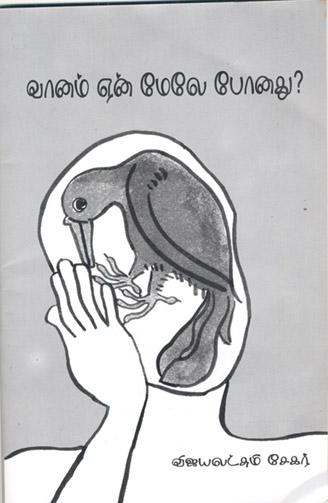
Her first short story collection titled “Why the sky went up?” was released in the latter part of the year 2006 and it was published by “Panikudam Publishers” a women’s collective with the collaboration of the Suriya Women Development Centre, Batticaloa, Sri Lanka.

S.Jeyasankar

THE SILENT GUARDIAN

“Silent Guardian”

The species which resist
The cruel control of
The mighty emperors;
Adopted themselves
To water cannons;
The disperser of
Campaign gatherings


Purging of water by cannons
The conventional disperse system
That applied democratically
To ensure
The law and order
And to maintain
A peaceful atmosphere
For the smooth running of
The wheels of mercenaries
The respectful agents of
The mighty emperors

To disperse the “unruly mob”
Protesting against
The cutting down of
Forests of woods
And the Breton woods
By purging water by cannons
Are not answerable now


The species which resist
The cruel control of
The mighty emperors;
Adopted themselves
To water cannons;
The disperser of
Campaign gatherings

“To save guard
The well being
Of the people”


Who wave the National Flags
From both sides of the parades
And make the nations proud
On the Independent days

The well dines and dressed
Brain washed intellectuals


Living in comfortable cubicles
Had answered again
To the demand
Of their Master’s call
And designed
The Silent Guardian


The US military's Active Denial System,
a non-lethal ray gun that fires microwaves
that makes people feel
they are about to catch fire.
Photograph: Elliott Minor/AP


The merciless weapon
The Silent Guardian
To save guard
The well being of the Masters
Against the vandals
Who protest and threaten
“The National Interests”
And
Against the
Horrendous terrorist too


How the wave device works?


Ian Sample, science correspondent
Friday January 26, 2007
The Guardian

It looks like a table top stuck on a Humvee, but to the US military it is a revolutionary new weapon, a controversial heat-ray destined to change the face of conflict by dispersing mobs, protecting military bases and sorting friend from foe without inflicting injuries.
Called Silent Guardian, the prototype fires a high-intensity beam of millimetre waves, inflicting a burning sensation like a light bulb pressed against the skin. After 12 years in development it has been demonstrated in public for the first time, at Moody air force base in Georgia.


Article continues...
________________________________________

AND THE TRAGEDY TOOOO


Friday, January 26th, 2007
http://www.democracynow.org/article.pl?sid=07/01/26/1559240


AMY GOODMAN: Marc Garlasco of Human Rights Watch joins us in the studio, senior military analyst at the organization, expert on non-lethal weapons. Gary Anderson joins us on the phone, retired Marine colonel, defense consultant in Washington, D.C. We welcome you both to Democracy Now! Marc Garlasco, can you describe further this weapon and what your concerns are?

MARC GARLASCO: Well, one of the problems that we have is that I can't do a very good job of describing it to you. I have gone and met with a number of military personnel and gone down to actually have conferences on the ADS, looked at video for footage on tests of the ADS, and spoken to a variety of military personnel on it, and yet they continue to hold back information from us. And one of the problems that we have is this veil of secrecy that they refuse to lift. We're not looking for any classified information on it, just for information basically to understand the legal and medical tests that have been undertaken on it. And so, I really can't describe in full this weapon, because of this veil of secrecy. And it’s incumbent upon the military to really lift that veil now so that we can have that discussion and debate on this really novel technology.

AMY GOODMAN: What do you feel when you're hit with it? I mean, reporters have been hit with it.

MARC GARLASCO: Well, we’ve been told -- I haven't been shot with it yet. I’m sure that they’re looking forward to getting me under the gun soon. I haven’t been shot with it yet, but from the video that I have seen and from speaking to people who have been hit with it, it’s an instantaneous heating, very quick, rapid, and you just want to get out of the way.


The species which resist
The cruel control of
The mighty emperors;
Adopted themselves
To water cannons;
The disperser of
Campaign gatherings


“When spiders unite, they can tie down a lion”
-Ethiopian proverb


The species which resist
The cruel control of
The mighty emperors;
Resisted with
Mighty power of hearts
With full of love
And spread the holy message…


The world is the visible heaven
For all living spices


S.Jeyasankar
27/28-01-2007

Friday, January 26, 2007


Vasuki J


Most of my paintings/sketches with figures of women are named as woman / no title. They are my expressions of being POWERFUL differently-The Tamil/eastern version of power is 'Shakthy' which is a feminine term and mostly connected to power of women. But in reality powerfulness became as a masculine character which is used to exploit the world to the maximum. These paintings are my inner self’s explorations of the love & nurture of the nature. ‘In search of the buried’ is actually a mixture of Suriyakantha, chemmani, sathurukkondan....and many corners of Sri Lanka, where women wander around to search their sons, daughters and husbands. Similarly ‘My child is not for war’ is not only the recruitments but also the struggle of women to protect their children from disappearances, arrests and killings.


Susiman Nirmalavasan
Activist Painter
1982-07-03
3, K.P. Nagar, Chenkallady, Batticaloa, Sri Lanka.

Exhibitions:

Solo:

2001- “Painting Exhibition of Nirmalavasan” - St. Michael’s College, Batticaloa, Sri Lanka.
2003- “Brush strokes of sufferings” - Auditorium, St. Michael’s College, Batticaloa, Sri Lanka.
2004- “Dialogues of feelings” - Art Studio, Dept. of Fine Arts, Faculty of Arts and Culture, Eastern University Sri Lanka, Batticaloa, Sri Lanka.

Exhibitions:

Group:

2002 – “Millennium Exhibition” - Central College, Kallaru, Batticaloa, Sri Lanka.
2002- “Exhibition of Local Creations and Local Industries”, Hindu College, Batticaloa, Sri Lanka.
2003 – Kala Pola, George Kyte Foundation, Colombo.
2003 – Exhibition of the Northeastern Provincial Council, Trincomalle, Sri Lanka.
2004– Kala Pola, George Kyte Foundation, Colombo.
2005- “Speaking Brush”, College of Education, Jaffna, Sri Lanka

*Nirmalavasan continuously working on issues connected with oppressions and his favorite target group is students and particularly with children.
He is very talented and committed applied artist and he improvised with natural and environmentally friendly discarded materials with the participation of children.

He applies the art of painting and sculpturing for collective creative experiences connected with the living environment of the children.

S.Jeyasankar

Sunday, January 21, 2007


Nations I


Mount “Sivanolipatham”*
The nations
Mighty symbol of integrity
Stood firm and serene

But the nations
Bear that Great Mount
Disastrously sliding down
Faster and faster
Like a huge rock
From the peak
Of a mountain

The buffoons in circuses
Exhibiting acrobatics
And balancing on the top
Of a huge ball
To make the crowed crazy

The leaders of the nations
Are balancing on the top of
Disastrously sliding nations
And
Make the people uneasy

*Sivanolipatham, a mountain in Sri Lanka where people of all cast and creed gather together for worship.

S.Jeyasankar
08.10.2006

Saturday, December 30, 2006

CHILDREN’S THEATRE FESTIVAL

CHILDREN’S THEATRE FESTIVAL
@
VIVEKANANDA LADIES MAHA VIDYALAYAM
MADDAKKALAPPU/BATTICALOA
SRI LANKA


CHILDREN’S THEATRE FESTIVAL
@
VIVEKANANDA LADIES MAHA VIDYALAYAM
MADDAKKALAPPU/BATTICALOA
SRI LANKA


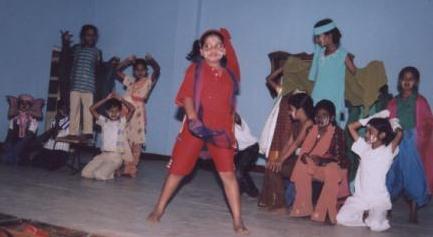
Affiliates of the THIRD EYE Local Knowledge and Skill Activists Group in collaboration with the VIVEKANANDA LADIES MAHA VIDYALAYAM, MADDAKKALLAPPU/BATTICALOA had conducted a THEATER WORKSHOP with the STUDENTS OF THE PRIMARY SECTION for two months and finally organized a FASTIVAL OF CHILDREN’S THEATRE on 2nd of December 2006.


Children’s Theatre Workshops and Children’s Theatre Festivals are alternative forms of education systems with the element of entertainment where children can discover themselves and express creatively and practically in performance with the facilitation of affiliates of the art of theatre.


Children,
Children with creative ability are our great source of prosperous
And for sustainable future!!!

S.Jeyasankar

Tuesday, December 26, 2006


He was an outspoken poet on the Tamil National Question

Source: Northeastern Monthly

An outspoken poet on Sri Lanka’s National Question,
S. Vilvaratnam, popularly known as ‘Vilvam’ or ‘Vilvar’ is
no more with us.

He died in Colombo of natural causes.


As a modern poet interested in contemporary social and political questions, Vilvam did not limit himself to pen and paper, but moved beyond the written word and fight for the causes he was committed to.


Vilvam as a disciple and co-activist of literary theorist and creative writer M. Thalayasingam, engaged in denouncing caste discrimination, the ever-bleeding tragedy of the Tamil community.


The genuineness of Vilvam’s voice on the issue surrounding the Tamil National Question is reflected in his poems, which will reverberate down the passage of years as written evidence of the yearning of a people engaged in a struggle for a righteous life.


Vilvam’s sense and sensibility in his celebrated work on the oppression of women in the Tamil community has a lesson in it to learn.


The inclusiveness in Vilvam’s perceptions as a committed Tamil nationalist contains a message about his life.

S.Jeyasankar

Sunday, December 24, 2006


Jesus

Painting of Vasan of Batticaloa, Sri Lanka.

S.Nirmalavasan is a young promising painter and an activist.

Monday, December 18, 2006


Arts - Speaking out against oppression from permitted spaces in modern Tamil theatre

By: S. Jeyasankar

Source: Northeastern Monthly

“….by the 1980s, the civil war in the North and East and the tensions and disruptions it caused, had made Tamil theatre almost non-existent other than in small pockets in the North and East.” (Sri Lankan Theatre in a Time of Terror: Political Satire in a Permitted Space, by Ranjini Obeysekere, Preface, page 16)


‘Kulanthai’ M. Shunmuhalingam pioneered the transformation of Sri Lanka’s modern Tamil theatre from an artist-centred product to a participant-oriented activity. Moved by the experiences of Tamils in this country, the veteran playwright has created different genres of plays for the contemporary stage.

He innovated and established the tradition of educational theatre with the participation of generations of Tamil theatre practitioners who were mostly his students. The special feature of educational theatre is to produce plays with the participation of students and teachers in schools through the facilitation of theatre practitioners, who are mostly teachers themselves.

Educational theatre plays the role of an alternate system of education where children can discover themselves collectively and become creators, instead of remaining crammers reproducing texts, which is the core of conventional rote-learning and the examination-oriented education system.

Educational theatre celebrates the diverse talents of the group, instead of cultivating few ‘memory makers’ in the classrooms. The production becomes a festival celebrating the talents and gifts of all the students.

Shunmuhalingam popularly known as ‘Kulanthai’ or ‘Shunner’ among Tamils and as ‘Shun’ among the others, innovated a method in educational theatre practice where students identify and select issues related to their world directly and indirectly, and discusses the issues, thereby creating a storyline.

Based on this storyline created with the participation of students, Shun writes the initial draft of the play, which is put forward for further discussion. Through continuous interaction and improvisation, the script is developed for the production.

K. Sithamparanathan, theatre activist and co-practitioner of Shunner, has contributed to making educational theatre into an art form with his creative skills and imaginative power as a stage director.

He has not only made a significant contribution to educational theatre with Shunner, but also to the tradition of political theatre in this country, which was initiated and pioneered by Professor K. Kanapathipillai and strengthened and extended by Ampalaththadihal, a cultural group connected with the Peking wing of the Communist Party.

Both Shunner and Sithamparanathan have contributed to stylised theatre as playwright and director, which has come to be popularly known as the ‘modern theatre of the Tamils of Sri Lanka.’ It has been imitated by different people at different levels and faces the criticism of being monotonous.

Sithamparanathan extended the aspect of participation in play-making into the process of the performance. He got himself out from the proscenium stage and auditorium to work with communities and later established and popularised participatory political theatre.

The participatory aspect which began by being practiced in educational theatre and later made inroads into political theatre has contributed to the establishment of a community-based applied theatre tradition among the Tamils of Sri Lanka.

The origins of various forms of community theatre lie in the educational theatre tradition of the Tamils of this country. It has now led to applying theatre as a research process and tool by the writer of this article. Participatory theatre action research is another fruit of the tree of educational theatre.

The concept behind reformulating traditional theatre (‘kooththu’) as an organic form of community theatre originated from the practices of educational theatre. Reformulation of traditional theatre such as ‘kooththu,’ is conceived to act as agent of integration against the disintegration of peoples and communities, which is a consequence of the imposition of modernisation.

Reformulation of traditional theatre is not to make it a showpiece or icon of cultural identity as required by national culture, or into a commodity as demanded by market culture. It is a medium of collective expression and action in the process of resistance and transformation.

Shunmuhalingam has also pioneered the tradition of children’s theatre among the Tamils of Sri Lanka. He is the master craftsman of the art of children’s theatre, contributing to it through his scripts and by training artists in this genre of theatre for the last 30 years.

Another important contribution to Tamil children’s theatre is the creations of Profesor S. Mounaguru. He has created children’s plays based totally on traditional Sri Lankan Tamil theatres. They are meant to be played on proscenium stages with traditional dances and music, and colourful stage décor.

Third Eye Local Knowledge and Skill Activists Group of Batticaloa is initiating children’s theatre performances with the facilitation of the writer of this article within traditional theatre spaces and in traditional style. The purpose of this exercise is to build community-based theatre for children.

In traditional theatres there is a little space for children. And creating a space especially for children in traditional theatre is an act of engaging the community in the play’s production process. And it could be said that the benefits of engagement are similar to the benefits when participating in the production process of adult theatre.

Shunner has been instrumental in popularising modern theatre of the Tamils of Sri Lanka. His signal contribution has been incorporating traditional and popular elements in drama. His scripts are stamped with comic wit, for which he has come to be known, in order to interpret contemporary experiences of oppression and resistance against it.

His plays brought out different layers of oppression on different segments of the Tamil community dominated by ethnic subjugation. In his plays he exposes human madness by making his characters laugh at their own words and deeds. People experience the poetic beauty of day-to-day speech in his written lines.

Shunner has imbibed the essence of Chekhovian, Ibsenite, Brechtian, and absurdist theatre and digested it with the fare of local theatre and cultural idiom. The demands of contemporary existence led him to this unique creative process. He is the genuine maker of people’s theatre in the proscenium stage of the Tamils of Sri Lanka and represents the voices of the people.

He is also the powerhouse of play scripts for modern, Tamil theatre. Other than his original works he translates plays of the world through English for performance. He has translated plays from all over the world and has brought in different experiences from Asia to Africa to Sri Lankan Tamil theatre audiences.

Other than script writing and translations he has also trained generations of theatre practitioners for more than 30 years. Most modern Tamil theatre practitioners, in Sri Lanka and the Diaspora, are directly or indirectly indebted to Shunner. He also teaches drama and theatre arts for students from schools and universities. He has taught the subject free for years in his house, Thayaham at Thirunelvelly, Jaffna.

It could be said that though an individual, he has played the role of an institution in the field of modern Tamil theatre. Generations of people involved in theatre activities with social commitment from all over the world where Tamils live, are students of Shunner.

In 1978 Shunner set up the Drama and Theatre School in Jaffna in collaboration with dramatists like A. Tarcicious and began producing modern plays with practitioners specially trained in modern theatre. They sought to establish a new theatre culture that was entertaining as well as educational and spoke the sophisticated language of the contemporary stage.

Shunner has also produced a substantial amount of reading material on theatre history, particularly on the history of world theatres, architectures of world theatres and the theory of drama in Tamil for students and practitioners. These materials have been used as a resource base in theatre studies in Tamil for more than two decades though not in printed form.

Departing from the modern fetish for diligently obtaining copyright for literary and artistic work, Shunner believes in the right to copy. Using his work freely is an unwritten practice among theatre practitioners, students and, especially, teachers of theatre. If these writings are systematically compiled, published and translated into other languages, the genuine face of the modern Tamil theatre (and even Sri Lankan theatre) will emerge; it will add to the power of South Asian theatre too.

His continuous and committed involvement in the field of theatre is not only due to his professionalism as a playwrite. He is also an activist. Shun never labelled himself as an activist but leads a life against all oppressive values, while never pretending to be someone who is purged of them.

The lone and silent Kulanthai M. Shunmuhalingam has created history when war, cultural silence, blockade, inappropriate pumping of funds (mis)rule the environment. Reading Shunner is to acquire for oneself the history of Tamil socio-political life during the period of the last three decades; understanding him means confronting the power of a an individual in a world full of people

Sunday, December 10, 2006

Tribute to Our Great Contemporary Poet
S. Vilvaratnam
On his sudden Demise

The Worship Scar
By S. Vilvaratnam

After my friend
Introduced his father,
Casually
I asked about the scar.
“This is Tholuhai – scar”
The Periyavar said
Stroking his forehead,
His eyes lighting up
I bit my tongue
Grieved
By my ignorance.
Calling for Allah
He had bowed low
Till his native soil
Scarred
His bowed forehead
Whence sprang my impudence
That dared chase them away
From the soil of their birth
Like striking
Their worship - scarred forehead
With a hammer?
How thus could I
Injure myself?
Their worship-scar
Seared
My guilt-stricken conscience scar
Like the third eye
They grilled and drilled
My battle-field scars too.
When, oh when will my scar
Disappear?
When, oh when will my crime
Of violating the soil’s beauty
Etched on their foreheads
Be expiated?
When from exile
They return home
And full-throatedly
Calling for Allah
They renew their worship-scars
And stroke their foreheads
The tears dammed up
For years and years
Will burst the eye-dykes
Only at the moment
I immerse myself
In that cleansing cataract
Will my blemish
Recorded by history
Be washed clean.
That moment only
Will consummate
My liberation.
Friend,
Allah have I entreated
To hasten
That sweet moment
Of reconcilement.

Translated By: A.J. Canagaratna

Source: Forehead Soil (1st ed. 2000)
(One of the poetry collections of S. Vilvaratnam)

Reproduced From
Third Eye (7th Issue January 2001)

Saturday, December 09, 2006

We Lost One of Our Great Contemporary Poet

We Lost
One of Our Great Contemporary Poet
S.VILVARATNAM
Today!!!
(09.12.2006)

Not to usual Unidentified Gunmen
But to unidentified illness!

A WORLD IN A FISTFUL OF SAND

By: S.Vilvaratnam

My son who was playing with sand
Came running up to me
And thrusting a fistful of sand
Into my palm
Ran off
Strewing the blossom of a smile.

The wet sand chilled
My still opened hand
A world blossomed
In the fistful of sand
And a white embryo sprouting wings
Began to toddle down it.

A ‘mini’ state in the compound
Where proudly I reigned my voice, my scepter,
My forefathers rejoicing at gatherings,
A full-blooded civilization, a way of life
Strode along the fistful of sand.

Today before our very eyes
Shared everything lies
Gouged is the land
We dangled in the void,
Our laboured breath hardnes,
Sticks in the throat.
Is such respiration life?
The sand in the fist
Trickles down
In the momentary weakness of memory.

‘Will everything slip out of our grasp?’
My troubled glance
Falls on my son
Playing with sand.
Once again my eyes glisten

Under a mango tree
That has put forth new shoots
Lovingly he kneads the sand,
Builds a temple, worships it.
Stoops, picks up handful of sand
And smears it, holy-ash-like, on his forehead.
Straightening up he sprinkles some verses
From the thevarams*
Much moved, transfixed I stood
Resolved to await
His hands’ action in Time.

*thevarams- devotional songs composed by saints of Hindu religion in praise of Hindu Gods.

(Translated by: A.J. Canagaratna)

THIRD EYE (THIRD ISSUE) DECEMBER 1994.

Note:
The funeral ceremony will take place in Colombo on Monday the 11th of December 2006.


Third Eye Local Knowledge and Skill Activists Group.