Tuesday, October 17, 2006


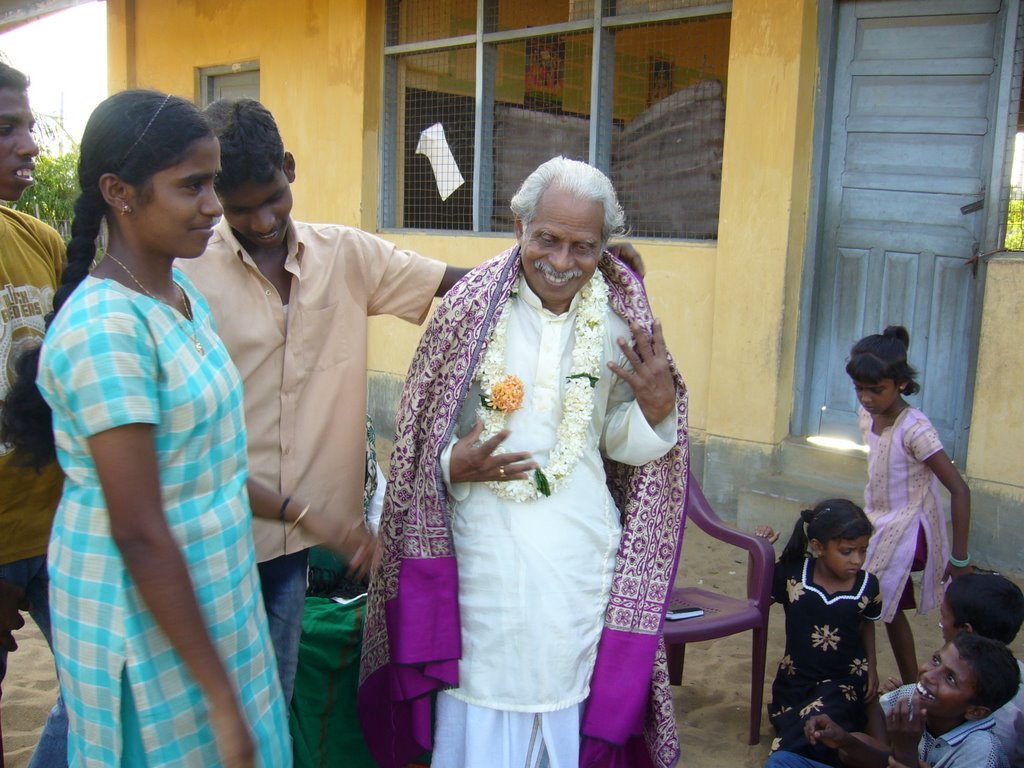
Annaviar Velmuruhu Thambimuththu:

A rare kind of Artist is living among us and Honored.


Velmuruhu Thambimuththu is one of the veterans Annaviar of the Eastern part of Sri Lanka. He was born in 05.07.1947 and residing in Siththandy, Batticaloa, Sri Lanka.

Even though Thmbimuththu Annaviar belongs to the tradition of an Annaviar family, other than to his father, he practices his art under the guidance of various Annaviars who were exponents in the art of Kooththu in the Batticaloa tradition.

Thambimuththu Annaviar is a specialist in both Vadamody and in Thenmody Kooththu (Traditional Theatre) of Batticaloa, Sri Lanka.

He is one of the very few artists who have the skill to make the instruments in the field of traditional arts. He is working with the Third Eye Local Knowledge and Skill Activists Group to share the rare quality of this kind of skill for the future generation.

The future of the art of Kooththu is heavily depended on the existence of art of making and repairing the instruments of the traditional arts. The commitment and contribution of Thambimuththu Annaviar in this regard is praiseworthy.

The involvement of Thambimuththu Annaviar in the Reformulation of Kooththu Program in Seelamunai, Batticaloa is also very commendable. His presence and contribution in the process of Reformulation of Kooththu Program shows the power of skills and knowledge of Annaviars to the younger generations.

The art of living of the artists like Thambimuthtu Annaviar in the communities are the essence of existence of art of Kooththu and the other traditional form of arts.

S.Jeyasankar
17.10.2006


AJ: The Deep Spring of Knowledge

There are no waves
There are no roars
There are no hard blows of winds

But
A spring
A deep and deep
Spring of knowledge
AJ
The Nilavarai* of intellectualism

The spring nourishes
The field of intellectualism
And yields flowers and fruits
Of hearts
With the love of humanity

Now, now
It remains and remains
Only in the hearts and minds

It’s always in the hearts and minds
Of spirits that urges
For the evergreen of the intellectualism
For the love of Humanity

Oh the generation of the future
Come, come and visit
The silent and deep Nilavarai
The spring of resource
And think of our Great AJ


S.Jeyasankar
16.10.2006

*Nilavaray – A bottomless and ever filled well in the northern part of Jaffna peninsula.

Friday, October 13, 2006


DEATH NOTICE


ALOSIOUS JEYARAJ CANAGARATNA
( A.J.CANAGARATNA)

26.08.1934 – 11.10.2006

A.J. Canagaratna who is known in the literary circle as AJ has passed away on the early hours of 11th October 2006 in Colombo hospital.

AJ has been a writer, critic and translator for more than thirty decades and well known among the Tamil, Sinhala and English literary circles.

He was also a versatile editor.
He worked as a feature editor for the Daily News and co edited the weekly Saturday Review with Gamini Navaratna.
He was also edited a journal of the Northern Co operative Union-“The Cooperator”
and in the editorial board of a Tamil weekly published in the 90s from Jaffna- THISAI.

A.J. has been a senior instructor in English at the English Language Teaching Unit at the Jaffna University from 1976 to 1992.

Recently he had edited the works of late Regie Siriwardana titled as “Selected Writings of Regie Siriwardena- Literature and the Arts” in two volumes published by the ICES, Colombo.

The remains of late AJ will be at A.F.Raymonds from 9.00 am to 4.00pm on 12th October, Thursday and will be cremated at 5.00 pm at the Jawatha cemetory, Colombo.

Our deepest condolence and respects to our great friend.

Good bye AJ!


Department of Languages & Department of Fine Arts
Eastern University Srilanka
11.10.2006

Thursday, October 12, 2006


A.J. Canagaratna
26.08.1934-11.10.2006

ALOSIOUS JEYARAJ CANAGARATNA


Dear Jayasankar,
I read your note on AJ. Recently Tamil Literary Garden of Canada honoured AJ for his outstanding contribution to Tamil by awarding him a special prize. It consisted of a certificate and cash prize of Rs 50000. This was delivered to him on the hospital bed on 30 September 2006. Kindly include this information in your note about AJ.

anbudan

a.muttulingam
*************************************************************************************
Dear Sivagnanam Jeyasankar ,
I send you my most sincere condolences.
Augusto Boal

*************************************************************************************
My dear Jeysankar,

I don't know what to say. We all have lost a great force of strength that stood by us. Last I saw him in May at Rosmead Pl. He went through my paper for the Canada conference. Never realised that it would be the last meeting.
Ragu
(Professor P.Ragupathy)

**************************************************************************************

Dear Jeya,
That is sad news. The end of a very unique and distinct life.
Darshan
(Dr. Darshan Ambalavanar)

Wednesday, October 11, 2006


A.J. Canagaratna
26.08.1934-11.10.2006


ALOSIOUS JEYARAJ CANAGARATNA


A.J. Canagaratna who is known in the literary circle as AJ has passed away
on the early hours of 11th (Wednesday) October 2006 in Colombo.

The remains of late AJ will be at A.F.Raymonds from 9.00 am to 4.00pm
on 12th (Thursday) October, and will be cremated at 5.00 pm
at the Jawatha cemetory, Colombo.

Third Eye
Demise of a Great Scholar


A.J. Canagaratna
26.08.1934-11.10.2006
ALOSIOUS JEYARAJ CANAGARATNA


The Power of A.J.Canagaratne

A Great Scholar of the Thamils of Sri Lanka Mr. A.J. Canagaratne was passed away on the early ours of 11th of October 2006 in his early seventies. He was a person who had functioned like an alternative Institution for generations of scholars who are marginalized by the ‘powerful people’ within the ultimate higher institutions among the Thamils of Sri Lanka.

A.J.Canagaratne never posed himself as an utmost Intellectual but generations of intellectuals and artists not only from Thamils of Sri Lanka or all the other nationals of Sri Lanka but also from people outside Sri Lanka will always respect his caliber.

The power and beauty of AJ is his genuine intellectual characteristic. He is always conscious of his words and the correctness of the information. He took much effort to share authentic information.

AJ is very strong enough to share new things to others and push them to new frontiers to bring fruits of knowledge and skill to the people who nourished the intellectuals with their hard earned money for the free education system.

The sharp and subtle arguments and interpretations of AJ are the fruits of his deep knowledge.

AJ is an intellectual of the people but he seldom uses the word people.

Brevity is the essence of AJ but he is an epic!

Sivagnanam Jeyasankar

Monday, September 18, 2006

INVITATION FROM THIRD EYE

The Hands that Yields Beauty
From
Nature’s Resources

An Innovative Exhibition and Sale
of
Creative Hand Yields

Organized By:
THIRD EYE Local Knowledge & Skill Activists Group

Venue:
Women’s Development Forum
# 27 A Lady Manning Drive, Batticaloa.

Date & Time:
24th September 2006,
At
10.00 AM to 05.00 PM

THIRD EYE

Local Knowledge & Skill Activists Group.

Sunday, September 17, 2006

Waves, Waves and Waves


'Waves, Waves, Waves':

I think it is a really powerful anthology of poems that provides a
profound, unsettling but also stimulating insight into the impact of
interventions - natural, economic, military, social, political and cultural -
on life in Batticaloa. Your critical voice, passionate commitment to
people's right of self determination and belief in the capacity and
resources of indigenous communities (their ability to secure their own
development and prosperity if only they were allowed to) is very well
expressed. The themes of development, education, natural resources, war and
globalisation have reach and relevance far beyond the village
communities of Batticaloa to which you immediately refer.

Yours is a unique perspective on the impact of the tsunami and the
destructive 'wave' of mostly Western intervention that happened afterwards.
It is a perspective that has not been heard enough by citizens of
Western societies responsible for so many problems across the world. It
would be good to do more to make sure these poems are widely read.

I found 'Mobile People' particularly uncomfortable and unsettling, and
will use the following passage in teaching of applied theatre students
in Manchester interested in 'theatre for development' -

Oh! What a great tragedy!
The experienced mobile people
Are in turmoil now
Not because of helplessness
In the hands of nature
But because of the restlessness
In the hands of neo invaders
Who came with their own prescriptions
And pills to relieve us
And with differently designed
Dissection tool kits and microscopes
And surely with pots of gold
In order to reconstruct us again
According to them in this neo global order (p16)

The title of the anthology expresses a sense of ongoing crisis of the
'developing' world as powerful nations find new 'globalised' ways to
exploit its resources. The tsunami emerges as a brutally real metaphor for
successive interventions that put the resources and infrastructure that
might otherwise guarantee prosperity for Sri Lanka at risk. The
ultimate tone is not negative however - the poem on the cover of the anthology
('We have to live!') expresses faith in the capacity of world and its
people to live better - a sentiment which I hope will stay with us all
despite the many difficulties that people struggle with all over the
world.


Jenny Hughes

In Place of War
Drama, Martin Harris Building
School of Arts, Histories and Cultures
University of Manchester
Oxford Road
Manchester
UK

Friday, September 15, 2006

Anger against invisible Neo-Colonialism

Anger against invisible Neo - Colonialism

An academic from Koandavil in Yaalpaanam teaching at the Eastern University in Vantharymoolai, writes poetry in English as well. His first collection of poems titled Waves, Waves and Waves published by the Third Eye Publication, has 30 poems. The book is priced at Rs.100 and is available from Third Eye English Forum at 30, Old Rest House Road, Maddakkalappu (Batticaloa).

The writer's name is Sivagnanam Jeyasankar.Jeyashankar is a lecturer in drama and theatre arts at the Eastern University and is also a theatre and research activist. His preoccupation is in the Thamil Kooththu (traditional theatre). He is himself a performer in theatre presentations. He writes essays as well. Besides these functions he also serves as the coordinator for Third eye Local Knowledge and Skill Activists Group and third Eye English Forum. S. Jeyashankar, while translating creative writing also occupies himself as co-editor of Third Eye Little Magazine in English and Moontravathu Kann Little Magazine in Thamil.

Lankan, Suresh Canagarajah who is a professor of English at City University of New York in his foreword to the book says: 'This book of poems narrates experiences we should all experience. We see people and soldiers caught in the ethnic conflict, aid agencies and the homeless facing the Tsunami, teachers and students grappling with intellectual dependency. The poet records voices. The rest of the world should hear voices of insight from people, deception from local media, condescension from foreign charities, terror from militia and authorities."

Literary editor A.J.Canagaratna (he edited the two volumes of Regi Siriwardena's Writing) calls Jeyashankar's poems 'a voice raised on behalf of our cultural identity'. He adds: It's all the more creditable that one who was educated in Thamil medium should be writing these poems in English…

It is but fitting that Jeyashankar who is deeply concerned about the cultural identities of the Thamils should be very involved in the Kooththu.

Here are some excerpts from Jeyashankar's poems which show his angst:

They always say
The doors are opened
I thrilled to see it
Because
I heard this
From my childhood

In y imagination
It is like
A postmodern construction
Constructed in an empty space
Only with
The opened doors
And alwaysTalking of
'Within the Constitution'
And the solution
To the problem
By the problem itself

They are always talking of
One Country
A Unitary state
But the fourth state
Always Flash
And open our minds
That it's their
fourth state
(Page 51)

Another satirical contribution is:
History registered
But not 'authentically
'Its disgraced chapters
On Aril 2006

Mothers mourn silently
In fear and in shame
On the eve ofThe Thamil New Year 2006
For the fate of their Working daughters
In the NGOs and INGOs
Not because of
The Atrocities
Of the aggressors
But because of their
Very own andInvisible sons
Innocents victimized
In order to domesticate

And the perpetrators
Silently harboured
The new version
Of an age old custom
Manipulated invisibly
But celebrated harshly
(Page 49)

Jeyashankar is clearly anti-colonialist as evidenced from some of his poems. What has he got to say about his poems? "My poetry collection is a spark among the sparks world over, in the process of exposing the invisible threats and dangers in order to create a world for all the species on mother earth".

Those interested in Sri Lankan Literature in English must read this collection as well and form their opinion.

By K.S.Sivakumaran
STANDARD News Paper
Sri Lanka

Tuesday, July 25, 2006

Forward of WAVES, WAVES AND WAVES

Foreword
By Prof. Suresh Canagarajah

Why would a person from a small island in the geopolitical periphery
write in the English language?
Why would he choose to sacrifice the millions of people
he can communicate to in the local language?

The simple reason is
a burning desire to communicate to the rest of the world
the thoughts and feelings of himself and his community.

Another reason could be the detachment the second language
gives from the immediacy of painful personal experience.

Yet another reason is the indirectness and obliqueness
to mask radical ideas and present them in harmless ways.

This book of poems narrates experiences we should all experience.

We see people and soldiers caught in the ethnic conflict,
aid agencies and the homeless facing the Tsunami,
teachers and students grappling with intellectual dependency.

The poet records voices the rest of the world should hear.

Voices of insight from poor people,
deception from local media,
condescension from foreign charities,
terror from militia and authorities.


Suresh Canagarajah
Professor, English
City University of New York.
April 30th 2006.

Saturday, July 22, 2006

Review: WAVES, WAVES AND WAVES

The Hidden Agenda

--By Frank Mackay Anim-Appiah, Nonviolent Peaceforce

A Ghanian Poet, Writer and Journalist


Title: Waves, Waves and Waves

Author: Sivgnanam Jeyasankar

Rating: Good

Publisher: Third Eye Publications

Reviewed by: Frank Mackay Anim-Appiah

Sivgnanam Jeyasankar is profoundly Sri Lankan whose writing profoundly catches the eye of the international reading audience.

Like others of his generation of Sri Lankan poets, Jeyasankar writes out a love of ideas and places. For him, the place is his home country, Sri Lanka.

As he touches on a wide range of subjects, education, history, environment, gender, human rights, violence, disease, humor and death, there is a driving force for his work, which is the very craft of writing.

Using his masters’ language, Jeyasankar paints very interesting pictures of the real situation in his country. His brilliance really comes out when he composes his poems in such a way that touch the inner feelings of his people. Whether it is a conscious effort to call his fellow citizens to action or not, Jeyasankar’s writing puts him squarely in his own class and provides his varied audience food for thought.

You cannot help but read him.

Wednesday, July 19, 2006

The Asian Network for Culture and Development


sends its heartiest best wishes to

THIRD EYE

and


Mr. SIVAGNANAM JEYASANKAR

at the occasion of the release of


"WAVES, WAVES AND WAVES"

(The poetry collection in English)


on Saturday, 22nd July 2006 at

Swami Vipulanandar Institute of Aesthetic studies

Kallady, Batticaloa.


******************

Upali Magedaragamage,
Coordinator,
Asian Network for Culture and Development (ANCAD),
63/2, Yahampath Mawatha, Piliyandala Road,
Maharagama 10280,
Sri Lanka.
Tele & Fax: + (94) 11-5526679 or Tele: + (94) 11-5522776
E-mail: intercom@colombomail.lk

Tuesday, July 18, 2006

WAVES, WAVES AND WAVES

INVITATION
From
THIRD EYE

Release of
“WAVES, WAVES AND WAVES”

A POETRY COLLECTION
IN ENGLISH

BY
SIVAGNANAM JEYASANKAR
OF
THIRD EYE

ON SATURDAY
THE 22ND OF JULY 2006

At
SWAMI VIPULANANDAR
INSTITUTE OF AESTHETIC STUDIES
KALLADY, BATTICALOA

TIME: 10.00am – 12.30pm

Chair:
Ms Rajini Francis

Chief Guest:
Prof. S.Raveendranath
Vice Chancellor,
Eastern University Sri Lanka

Reviewers:
Prof. Ms. Sitralega Mounaguru
Mr. Frank Mackay Anim Appiah
A Ghanian Editor, Writer, Poet.
Prof. Ms. Patricia Lawrence

*Special Performance: “Rhythms of Traditions”
By
Affiliates of the THIRD EYE

Thanks

THIRD EYE
English Forum &
Local Knowledge and Skill
Activists Group


Moondravathukann
Third Eye
We as a group work alternative to globalization, which suppresses the differences in the multicultural world. We value all the species as equal and believe that they have the right to live on the planet earth. To achieve this aim we promote people centered creations instead of Multinational company productions. To create a dialogue on these issues we conduct workshops, seminars, informal discussion groups, in the Universities, Schools, Villages and at other social events and publish a Little Magazine “Moondravathu Kann”. We use art forms such as different theatre forms, songs, cartoons, and paintings to make a dialogue on these issues. Also translate articles, poems, news items, interviews, short stories and dramas on the above issues from English to Thamil. We try to bring out the voice and skills of the people who are engaged in activities related to our aims and objectives.

Monday, July 17, 2006

INVITATION

INVITATION
From
THIRD EYE

Release of

“WAVES, WAVES AND WAVES”

A POETRY COLLECTION
IN ENGLISH

BY
SIVAGNANAM JEYASANKAR
OF
THIRD EYE

ON 22ND OF JULY 2006

At
SWAMI VIPULANANDA
INSTITUTE OF AESTHETIC STUDIES
KALLADY, BATTICALOA

TIME: 10.00am – 12.30pm

*Special Performance: “Rhythms of Traditions”
By
Affiliates of the THIRD EYE

Thanks

THIRD EYE
English Forum &
Local Knowledge and Skill
Activists Group

Sunday, July 02, 2006

Unitary State But Separate Fourth State

They always say,
"The doors are opened”

I was thrilled to see it
Because
I heard this From my childhood

In my imagination
It is like
A postmodern construction
Constructed
In an empty space
Only with
The opened doors

And always
Talking of
“Within the Constitution”
And the solution
To the problem
By the problem itself

They are always talking of
One Country
A Unitary State
But the fourth state
Always flash
And open our minds
That it’s their fourth state

S.Jeyasankar
19.06.2006

Wednesday, June 21, 2006

It's NOT our destiny

It’s not our destiny
When time to time
People intrude as illegal
And enslave us as barbarians
Manufacture their exploiting missions
As missions of civilization

Our past generations
Not only our forefathers
Fought for liberation
And brought down
The flags of the civilizers
But some of our forefathers
Made themselves as rulers
And made the freedom
As an annual event
At the freedom square
With the hoisting of Flag
Which they said
“It’s ours”
And invites missions
With red carpeted welcome
To democratize ourselves
And were made us to live
A humanitarian life
According to them

Genuinely it’s not our destiny
But our total blindness
Of the Third Eye

S.Jeyasankar
05.06.2006

Fear of Death or Thinking of Justice

Fear of death
or
Thinking of Justice

Fear of death engulfs
When thinking of justice
Even for a right to drink
A drop of pure water
In a world
Where it was transformed
As a commodity
And patent right to MNCs
Those have the capability
To supply coke or Pepsi
Where there is no water.

S.Jeyasankar
05.06.2006

Elegy for Thamil New Year 2006

Elegy for Thamil New Year 2006

Source: Northeastern Monthly - June 2006
By: S. Jeyasankar

Mothers mourn silently
In fear and in shame
On the eve of
The Thamil New Year 2006
For the fate of theirWorking daughters
In the NGOs and INGOs

Not because ofThe atrocities
Of the aggressors
But because of their
Very own andInvisible sons

Innocents victimized
In order to domesticate
And the perpetrators
Silently harboured

The new version
Of an age old custom
Manipulated invisibly
But celebrated harshly

Monday, June 05, 2006

Gender: Violence against women

Gender: Violence against women – what it means in a society struggling for freedomBy: S. JeyasankarSource: Northeastern Monthly - June 2006
Statistics reveal that violence against women at home is much higher than what is experienced by them at their places of work, or out on the streets. But when concerned people, mostly women, start to speak out on violence against women at home, or domestic violence, there is a loud outcry by men that women are creating chaos within the home and breaking-up families by interfering in matters that are, essentially, between husband and wife, or at most within the extended family.
No one says women should get out of their homes because of domestic violence perpetrated by men, particularly husbands or fathers. But at the same time, the home is not a torture chamber for women. It should be a place where there is love, peace and understanding. Raising the issue of domestic violence is to make the home become a place of love for all members of the family.
It should be the same story when it comes to places of work. Work places are not only for men but also for women. If anyone is harassed or experiences violence in their work place, the perpetrators must be held accountable. Meanwhile, gender balance of the work place must also be maintained.
The question is: when women face harassment and abuse – especially sexual harassment at the work place – is it reasonable to ask them to leave the place of employment for their own safety or dignity? The answer should be no. On the contrary, the perpetrators should be dealt with and the security and dignity of the victim restored. But restitution, which is a common rule applied whenever injustice is committed, has become an exception for women.
This is the theme of the saga involving the infamous CD with pornographic material that was circulating in the Batticaloa and Ampara districts around the time of the Sinhala and Tamil New Year and sensationalised by the media with palpable glee.
The girl who had allegedly appeared in the porn CD was identified as a native of Sri Lanka’s east and located as working in an NGO or INGO. A story was then fabricated and disseminated with the ingredient of a death threat included, based on the ‘information.’ This was apparently done to safeguard the dignity of the women working in NGOs and INGOs.
But the whole thing boomeranged when it made working women in the NGO sector easy targets in the hands of their own brethren in every sphere of their day-to-day existence – particularly during the Tamil New Year.
The situation took an ugly turn when personal grudges began to be played out under cover of the death threat and the accompanying humiliation. Some individuals identified certain women workers as “the girl” in the porn CD and concocted stories. These rumours gained currency and began to haunt the families of many young girls working in NGOs and INGOs. Thus the misplaced attempt at preserving female ‘virtue’ led to a tragedy in the lives of working women in this sector.
A girl committed suicide, and there was talk of other girls too contemplating taking their own lives. Whatever it might be, it is undeniable that all the working women and their families in the Batticaloa and Amparai districts who are working in the NGO sector have suffered deep mental distress.
Mothers of young working women in the NGOs and INGOs have also become victims. Mothers not only feel ashamed and humiliated because of the gossip, but fear death threats on their daughters could be carried out. What is more, they fear for their future in societies where even a hint of scandal could lead problems in finding husbands.
Ironically, working women in the NGOs and INGOs did not experience humiliation in the hands of ‘enemies.’ The usual forces resisting enemy atrocities kept silent and treated the issue as a private matter only concerning women.
The character assassination campaign against individual working women in NGOs and INGOs was a way to humiliate them and bring them to disrepute. The representation of these women as ‘loose’ puts their safety and security into question. Apparently, a society’s conventional understanding of safety and security of the individual does not apply to the security of working women in relation to the perpetrators of cultural violence.
Even though the cry of cultural degeneration brought about by the ‘misbehaviour’ of women working in NGOs and INGOs are very loud, no one is bothered about the true identity of the girl or spare a moment of sympathy for the predicament in which she is now. Nor does anyone care about the man who appeared in that particular pornographic CD, or what motivated the perpetrators to do what they did. Instead the incident was brutally exploited to demoralise working women in the NGO sector so as to ‘domesticate’ them.
It is very important to discuss why the working women in the NGOs and INGOs are targeted It’s a very bad symptom of a dangerous sickness and the community must be raise its concerns about it.
Is society nervous about the smart and self-reliant, independent women?
The other important issue is the silence of the males – especially the top brass of NGOs and INGOs despite all these organisations claiming to be gender sensitive and concerned about gender components in their programmes.
It is also interesting to note that important social and political issues in Batticaloa and Amparai raise a host of responses based on ethnic, religious, caste and other differences. On this occasion however, all social groups appeared united in banishing women back to the kitchen.
Because of the strong NGOisation of gender, modern and progressive male intellectuals and male artists usually claim that the issue of gender and feminism are imported (but not modernism or Marxism or nationalism).
Role of print media in this regard is very critical. The print media came out as one sided and authorised and legitimised the manipulation of the invisible hand which affected the dignity of working women in the NGO sector. It is very sad to note the role played by the print media in that it failed to take into account the suffering of the victims of the ‘information manipulation.’
The interesting side of the story is how the print media in English, which carried articles on the problem regularly, mostly on their front pages, represented the issue. Not a single media institution was concerned about the vulnerable situation of working women in the NGO sector. Nor were they interested in applying rigorous standards of investigative journalism that they apply to politics or in relation to political killings.
The collective violence waged against women working in NGOs and INGOs in the Batticaloa and Amparai districts is a serious issue and has to be dealt with. And it has to be dealt with as the problem per se and not on how it affects the political and ideological persuasions of the various actors – individual and collective (and mostly male) – who have been using such issues for selfish ends. The manner in which it is dealt would also be a good yardstick to evaluate the true nature of a society which has been involved in a freedom struggle for more than three decades.
Elegy for Thamil New Year 2006

Elegy for Thamil New Year 2006
Source: Northeastern Monthly - June 2006
By: S. Jeyasankar


Mothers mourn silently
In fear and in shame
On the eve of
The Thamil New Year 2006
For the fate of their
Working daughters
In the NGOs and INGOs


Not because of
The atrocities
Of the aggressors


But because of their
Very own and
Invisible sons


Innocents victimized
In order to domesticate
And the perpetrators
Silently harboured


The new version
Of an age old custom
Manipulated invisibly
But celebrated harshly

Challenges and Empowerment of Feminists Activism

“Challenges and Empowerment of Feminists Activism”

A seminar on “Challenges and Empowerment of Feminists Activism” was organized by the THIRD EYE Local Knowledge and Skill Activists Group on Saturday 03.06 2006 at the Teachers’ Training College, Batticaloa, Sri Lanka.

Papers presented and followed by discussions in two panels from 9.30 am to 12.30 pm.
Cultural activists of the THIRD EYE performed songs in between the presentations.

Program

Well Come Speech
Chair Person’s Address
Song

Panel One
Facilitator: Kamala Vasuki

Key note speech: Vijayaluxmi Sekar*

Presenters and Papers:
S. Renukarani: Challenges of initiating and establishing of Cultural Activists Group to eliminate the violence against women.
T. Gowreeswaran: Activism of Men against violence against women.

Song

Panel Two

Facilitator: S.Jeyasankar

Key note speech: Majitha Hanifa*

Presenters and Papers:
S. Chanthirasekaram: ‘Seeddu’ the local saving system as a tool of empowerment of women and strengthen their collectivity.

K.Kalaimahal*: Local Poultry Development as a tool of empowerment of women and strengthen their collectivity.

Song

Vote Of Thanks

* The Keynote speakers and a presenter were unable to attend the seminar due to prevailing situations.

Tuesday, May 30, 2006

Children's Festival of Kumarapuram, Batticaloa!

Children’s Group of the Third Eye in Kumarapuram, Batticaloa, Sri Lanka had celebrated its Sports Festival on Sunday the 28th of May 2006. The Master story teller of the Thamils of Sri lanka Master Sivalingam was honored by the children of Kumarapuram and Annaviyar Mr. M. Panchacharam grace the occasion. Annnaviyar Mr. M. Panchacharam was a specialist in Kooththu, the traditional theatre of the Thamils of Sri Lanka and trained Kooththu for children throughout the years.

Honoring Master Storyteller Master Sivalingam


Children's Group of the Third Eye Local Knowledge and Skill Activists Group Honoring Master Storyteller Master Sivalingam

Tuesday, May 23, 2006

Signs of thumps up

Signs of thumps up


Signs of thumps up
Of the state economists,
Symbolize the strength
Of state economy
In media

Men and women of the state
Struggles to meet the both ends

The real situation
Is scientifically different,
Statistics, read accurately
And interprets appropriately

Graphs in the authentic reports
Always moving upwards
To the satisfaction
Of the people in power
In order to gain
The hearts and minds
Of the people of their state

Academics are busy
With quoting latest data
For their current commitments

Still men and women of the state
Struggles to meet the both ends

S.Jeyasankar
12.01.2006
It’s a Different Country

Three hearty cheers for Tea pluckers
Heep Heep Hurrey!!!

Three hearty cheers for Garment workers
Heep Heep Hurrey!!!

Three hearty cheers for House maids
Heep Heep Hurrey!!!

The economic burden of the country
Is on the shoulders of women
Women are the back born of this nation

But men are really worried about
The double burden
Of working women

And shoulder the burden
Of the politics on them
And manage the country
To get rid of from
All the impediments
By militarizing
By privatizing
By liberalizing
By globalizing

And even celebrates
The Women’s Day on March Eight
To make the working women happy
As in May First of every year
To make the working class happy

Naturally
Men are good politicians
And some are with
Extra ordinary capacities
Capable of leadership
To raise the flags
On the “Annual Independence Day”

Hail the politics
Of the Manhood
In the “Pearl of the Indian Ocean”


S.Jeyasankar
12.01.2006